Industry Sponsor
Proactive AI Agent for SAAS Platform
To help maintain accurate and trustworthy journey maps for CXs
*NDA Notice
Confidential and proprietary details have been removed or anonymized to protect client information.
Project Overview
The Dish in One Bite

Problem Space
Journey maps go stale fast, and keeping them current means manual reviews across disconnected data.

Business Goal
Turn journey maps into living tools that enterprise teams trust and keep coming back to.

Result
An agentic AI that flags outdated steps, traces data changes to the journey, and suggests evidence-based updates for users to approve.
Customer journey maps are meant to guide business decisions, but they quickly become outdated as customer behaviors, products, and data evolve. Even with AI-assisted creation and insights, maintaining maps on the platform still relies on manual reviews and disconnected signals. My team and I designed an agentic AI maintenance system that detects outdated content, maps data changes back to specific journey steps, and surfaces evidence-based suggestions for users to review and apply.
Ingredients for this Project
Timeline
Jan 2026 - May 2026
My Role
UX Designer
Responsibility
UX research
Literature Review
Sketching
Interaction Design
Usability Testing
Design Iteration
Tool
Figjam
Figma Board
Maze
My Key Contribution
Led Hi-Fi Prototyping & Built a Component System from Scratch
Created the Testing Protocol, Conducted Research & Synthesized Findings
Helped Coordinate Project Planning & Team Scheduling
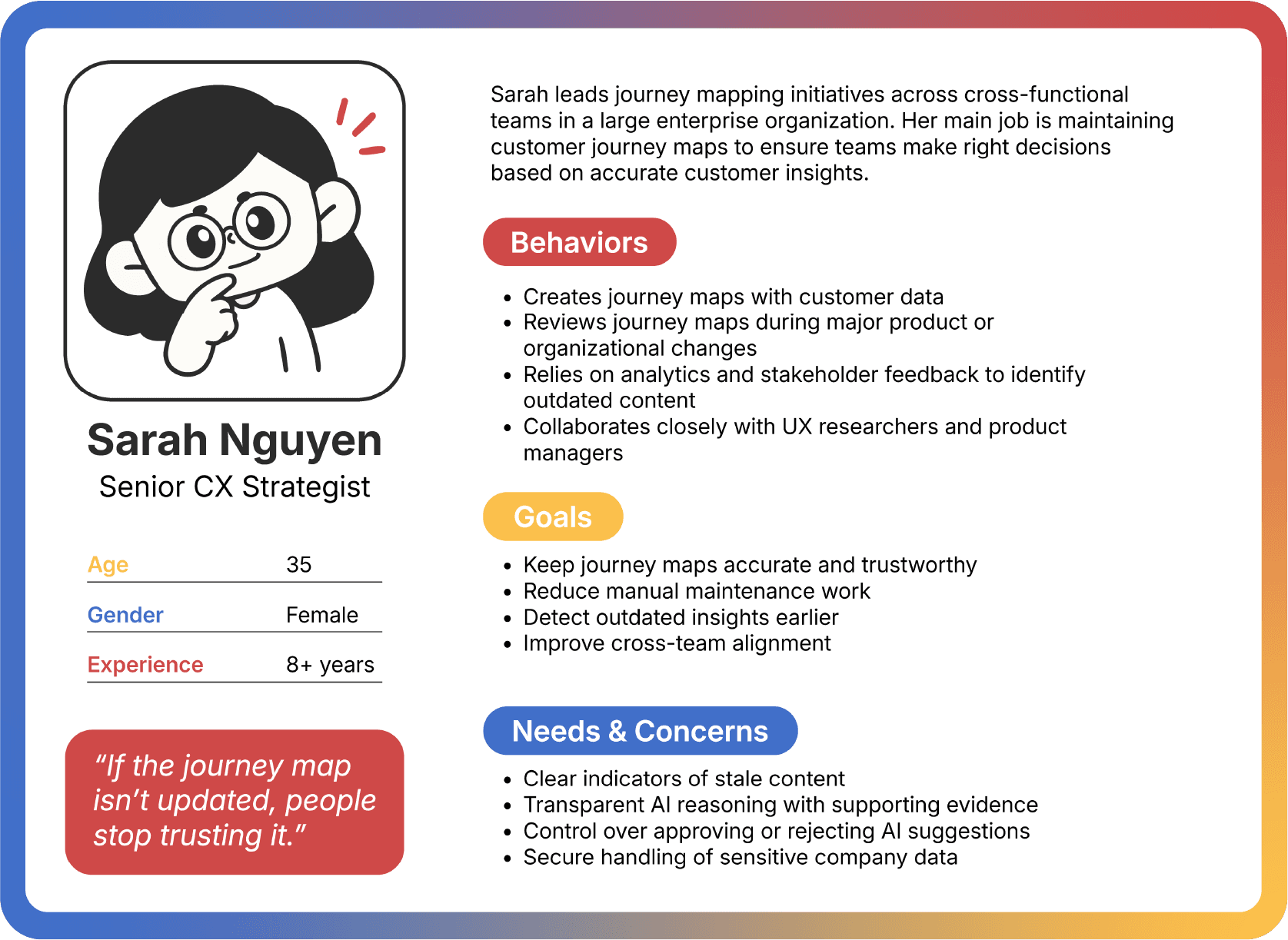
User Persona
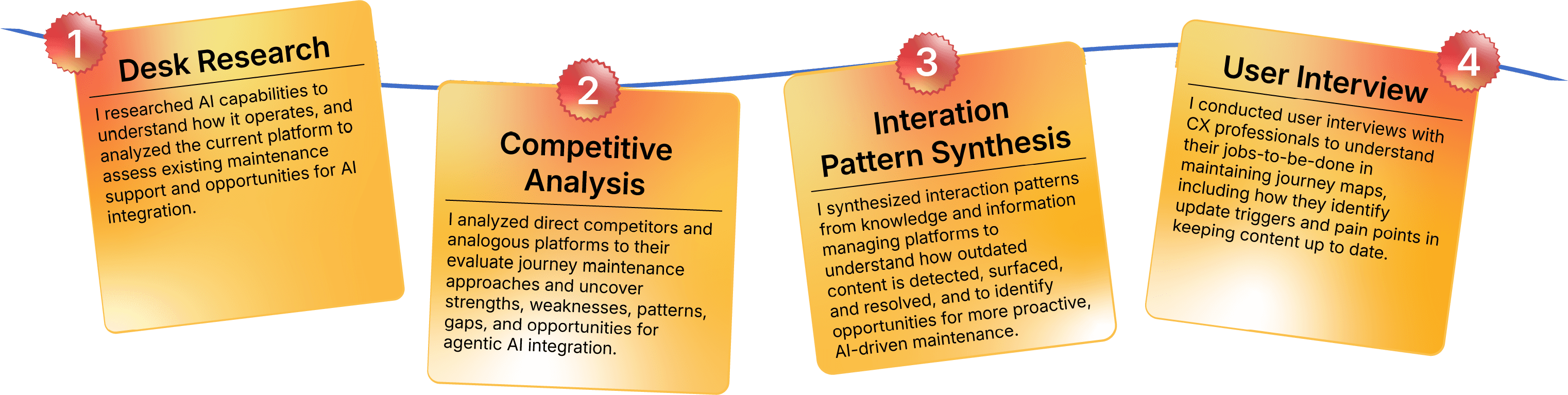
Preparation
What I did before finding solutions
Final Product
How I Cooked the Final Solution
Research gave us the ingredients. Here's how we turned them into something users could actually taste-test. Here are the steps me and the team took:
Crazy 8's & Whiteboarding: Six concepts sketched, then narrowed down with our sponsor.
Wireframing: Merged two concepts into one AI agent after seeing how much they overlapped.
Hi-fi Prototyping: Built the evidence cards, walkthrough, and history view.
Usability Testing: 6 participants, 2 navigation versions, 3 tasks.
Iterating: Clearer evidence interactions, easier-to-read cards, and a separate home for the agent.

Final Product
My Final Decision for Agentic AI Solution
The final design solution introduces an AI maintenance agent that helps teams keep customer journey maps accurate and up to date over time. Instead of relying on manual reviews and scattered signals, the system proactively surfaces suggested updates, explains the reasoning behind them with supporting evidence, and guides users through the review and application of changes. To balance automation with trust and control, the experience combines proactive AI suggestions with reactive conversational assistance, allowing users to explore, verify, approve, deny, or revisit recommendations directly within their workflow.
Here is the logical flowchart of our final solution for communication and teamwork purposes.
Proactive AI Suggestions
The AI maintenance agent proactively monitors journey data and surfaces suggested updates when information may be outdated, inconsistent, or missing.
Reason: In our interviews, users said there was no clear signal for when a journey needed updating. They relied on noticing changes themselves, so maps often fell behind reality.
Evidence-Backed Suggestions
Each suggestion includes supporting evidence and contextual reasoning to explain why the AI recommended the change. Users can review related insights and source documents to manually verify the suggestion before taking action.
Reason: Users told us AI outputs must be defensible before they can share them with stakeholders, and their comfort with AI grew when they could see the data behind it.
Contextual AI Assistance
Users can ask the AI follow-up questions about specific suggestions to get additional context, explanations, or clarification directly within their workflow.
Reason: In usability testing, moving between a suggestion and a separate chatbot felt tedious, so we brought the chat into the suggestion itself.
Human-Controlled Decision Making
The system keeps users in control by allowing them to approve, deny, or skip AI-generated suggestions rather than automatically applying changes. This helps balance automation with trust and human oversight. Suggested areas are highlighted directly within the journey map to help users quickly identify where attention is needed.
Reason: Users wanted AI to support their work, not replace their judgment. Most still expected to verify changes and preferred thoughtful human involvement over full automation.
Suggestion History & Undo Actions
Users can revisit previously approved or denied suggestions via a history view that tracks past actions. This also allows users to review context and undo decisions when needed.
Reason: In our competitive audit, users of other tools couldn't view or restore the previous state after an AI change. We designed so that no decision is final.
Key Takeaway
Project Leftover and Lesson
What I learned
Communicating Ideas More Clearly Across Teams
I learned to communicate design decisions more clearly through structured reasoning, technical language, and evidence-based discussions. I also created logic flowcharts for the first time to better communicate the system's behavior to engineering-oriented stakeholders.
Building Scalable Hi-Fi Prototypes
I gained experience creating scalable component systems and maintaining consistency across large hi-fi prototypes. I also learned how important clear documentation and communication are when working within shared design systems.
Creating Better Collaboration Frameworks
I learned that teamwork is not only about contributing individual work, but also about creating clarity and support for the team so we can succeed together. I practiced building structured frameworks like usability testing and interview protocols to help teams collaborate more consistently.
Designing with Business Goals in Mind
Working closely with stakeholders helped me better understand how UX decisions support broader business goals, product strategy, and long-term platform value.
What I would do with more time
Conduct More Usability & Contextual Testing
I would conduct additional rounds of usability and contextual testing on the final solution to further validate interaction flows, reduce confusion between AI features, and better understand whether the system genuinely helps teams maintain journey maps more effectively in real working environments.
Design an Onboarding Experience for this AI Feature
Since the platform already contains multiple AI capabilities, I would explore onboarding flows and educational moments to help users better understand the purpose, behaviors, and value of the new AI maintenance agent.
Revisit AI Support for High-Security Organization
Some organizations had strict restrictions around external AI tools due to data privacy and security concerns. With more time, I would further explore alternative workflows and system behaviors that could better support those enterprise environments.